Tree House
P.S. I Still Love YouThe Tree House is both a physical refuge on the eve of its destruction and a repository of Lara Jean Song Covey’s childhood attachments. As it faces demolition and replacement by a gazebo, its familiar floorboards, window, walls, and ladder become the setting for a reckoning with friendship, jealousy, and love. A friendship bracelet hidden in the floor brings the past into the present; a nighttime visit from Peter Kavinsky makes the Tree House the place where Lara Jean chooses a less guarded future.
Setting and impending loss
On the night before the Tree House is to be bulldozed, Lara Jean lies on her back looking through its window at a moon shaped like a clipped thumbnail. The next day, the structure will be gone and a gazebo will take its place. That impending change gives the room a different weight: Lara Jean has barely thought about the Tree House recently, but its disappearance makes her sad. She understands the feeling through childhood toys, which become important when they are no longer available, yet the loss reaches beyond the building itself. To her, the Tree House’s end feels like a goodbye to childhood and to the people and experiences that once filled it.
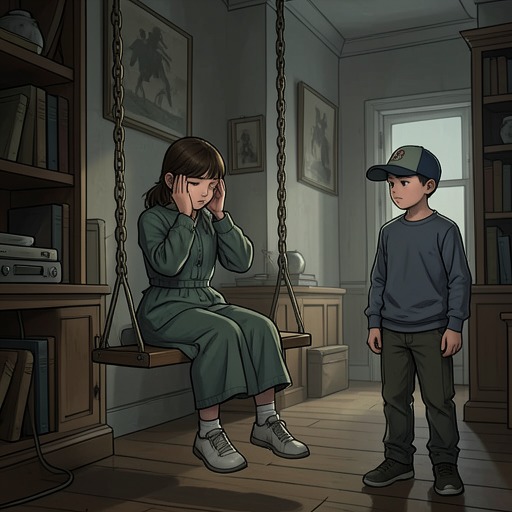
The scene establishes the Tree House as an intimate interior through a handful of precise details. Lara Jean lies by the window, notices something emerging from a floorboard, and later sits opposite Peter against the walls. Peter climbs up the ladder quickly, ducking to avoid hitting his head on the ceiling. These ordinary features give the conversation a specific, enclosed setting: the characters are not meeting in an abstract memory of the past, but in a place that is physically about to vanish.
The bracelet and childhood memory
While sitting in the Tree House, Lara Jean notices purple string poking out of a floorboard like a blade of grass. She pulls it free and recognizes Genevieve’s friendship bracelet, the one Lara Jean had given her. Its small, material presence revises the story Lara Jean has been telling herself about their friendship. She recalls believing they stopped being friends from that point onward, but recognizes that this cannot account for their sleepovers, birthdays, or the time Genevieve cried because she feared her parents were divorcing.
The bracelet matters because Genevieve had placed it in the time capsule as her most treasured possession, just as Lara Jean had placed in hers what mattered most to her. At the party, Genevieve took it out and hid it rather than let Lara Jean see it. In the Tree House, the recovered bracelet gives Lara Jean evidence of an affection she had thought was lost or perhaps never genuine: she had mattered to Genevieve, and the two had been true friends. The object does not undo their later estrangement. Instead, it preserves a more complicated history than Lara Jean’s hurt had allowed her to believe.
The Tree House also gathers several kinds of farewell into one place. As Lara Jean holds the bracelet, she says goodbye in her thoughts to Genevieve, her middle-school years, the Tree House, and everything that mattered to her during one hot summer. She broadens that loss into a reflection on how people can be someone’s whole world for a time and later no longer be close. She remembers that Josh is no longer a constant in her life and that living without Margot nearby has been harder than she once imagined. The Tree House gives those separate departures a common setting without making them the same loss.
Peter’s visit and the final conversation
Peter calls to Lara Jean from below in the dark, and she answers that she is there. He climbs the ladder and settles against the opposite wall. Lara Jean tells him the Tree House will be demolished and a gazebo built in its place; when he asks why she called him over, she explains that she knows Genevieve’s secret. The threatened destruction of their childhood place thus forms the setting for a conversation that had been held back by secrecy.
Peter tells Lara Jean that Genevieve’s father had cheated on her mother before, though never with someone so young. When Genevieve’s parents’ problems grew severe, she sometimes hurt herself. Peter had felt responsible for protecting her and admits that he liked being needed, even though the situation frightened him. He also recognizes that he had known Genevieve could be manipulative and had sometimes returned to their familiar dynamic because he was afraid. His explanation makes their lingering connection less a simple romantic rivalry than a pattern shaped by fear, care, and the comfort of what Peter already knew.
Peter then explains that he feared disappointing Lara Jean. Because he knew sex mattered to her and believed she was innocent, he worried that his own past would cause him to mishandle their relationship. Lara Jean realizes that she, too, has been measuring herself against Genevieve and treating Peter’s earlier relationship as the standard their own could not meet. She concludes that Peter was not the only one who needed to get over Genevieve; Lara Jean had also been unable to let her go, and had not given her relationship with Peter a fair chance.
From memory to a new beginning
Peter asks what Lara Jean wishes for now that she has won the game. She wishes that they could return to being themselves together, have fun, and share a sweet first romance she can remember all her life. His response challenges the expectation that their relationship is already doomed. He proposes going all in without their contract or its safety net, accepting that Lara Jean might break his heart. In the Tree House, the conversation moves from the fear of repeating old pain to a mutual willingness to risk it.
Lara Jean places her hand over Peter’s heart, then takes his hand and places it over hers. She tells him to take good care of her heart because it is his. They hug and kiss, both shaking, as the narration marks the night as the one in which they become real. The Tree House’s impending disappearance sharpens, rather than resolves, the scene’s concern with change: it cannot restore childhood, recover an uncomplicated friendship, or guarantee that love will last. It can hold the conversation in which Lara Jean stops asking love to be protected from all risk.
That choice echoes earlier ideas about romance without making the Tree House a setting for every stage of the relationship. Lara Jean had once described the appeal of old-fashioned, casual dating and hoped that a breakup would not make it impossible to remain friends. She had also treated small courtship rituals, including a handmade Valentine for Peter, as ways to acknowledge their relationship. By the final Tree House conversation, the question is no longer how to make romance safe through a contract or a script. The discovered bracelet preserves evidence that a friendship mattered even after it changed; the couple’s decision to risk their hearts accepts that closeness, too, can involve uncertainty. The Tree House stands at the crossing of those two recognitions, as a place where the past is neither erased nor mistaken for a promise that nothing will change.